Coinbase Brings Apple and Nvidia On-Chain: What Do You Actually Own?
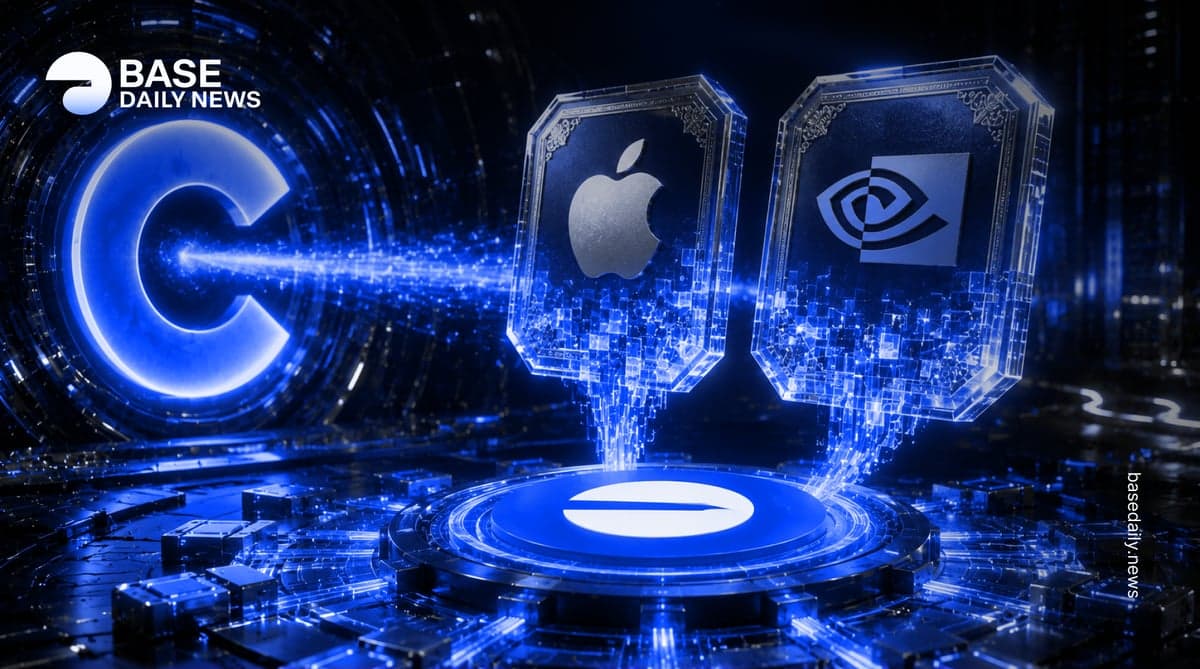
Coinbase is bringing some of the world's largest publicly traded companies onto the blockchain through tokenized stocks on Base.
The initial lineup includes Apple, Nvidia, Meta and Alphabet, giving eligible users outside the United States access to blockchain-based representations of the shares that can be held in self-custody wallets, traded around the clock and used across supported DeFi applications.
The launch represents another step toward connecting traditional financial assets with onchain markets. But there is an important distinction investors need to understand: buying a tokenized stock is not exactly the same experience as purchasing a conventional share through a traditional brokerage account.
Coinbase Brings Four Major Stocks to Base
Coinbase has launched tokenized versions of Apple (AAPL), Nvidia (NVDA), Meta (META) and Alphabet (GOOGL) on Base.
The tokens are issued as B20 tokens and are designed to give eligible investors economic exposure to the corresponding underlying equities. Coinbase says each token is backed 1:1 by a real share held through regulated custody arrangements.
Unlike traditional stocks, which generally trade during established market hours, the tokenized versions can be traded 24 hours a day, 365 days a year on Base. Base's tokenized-stock overview explains how these assets can interact with the onchain ecosystem.
The products are currently subject to geographic and regulatory restrictions. Coinbase states that its tokenized stocks are offered under Regulation S and are not available to U.S. persons or in certain other restricted jurisdictions.
Do Tokenized Stocks Mean You Own the Actual Share?
This is the most important question surrounding the launch.
Coinbase describes its tokenized stocks as blockchain tokens representing a beneficial claim on a real underlying share. The underlying shares are held in regulated, bankruptcy-remote custody, while Coinbase issues the corresponding tokens on Base.
That means the token is not simply a synthetic price tracker with no underlying asset. Coinbase says the structure is backed 1:1 by the actual stock and gives holders a claim on the underlying equity.
However, investors should still distinguish this structure from holding a conventional brokerage account position. The token exists within a specific legal and custody framework, and its availability, transferability and rights depend on the product's terms and applicable regulations.
Coinbase's documentation also says dividends and stock splits are handled through an onchain multiplier. Rather than changing the raw number of tokens, the multiplier adjusts the share-equivalent value, with dividends reinvested after applicable withholding and fees.
Why Put Stocks on a Blockchain?
The biggest difference is not simply where the asset is stored. It is what investors can potentially do with it.
On Base, tokenized stocks can be held in self-custodial wallets and integrated with supported DeFi applications. Base specifically highlights the ability to lend, borrow against or otherwise use tokenized stocks as collateral across its DeFi ecosystem.
That changes the traditional concept of a stock from an asset sitting inside a brokerage account into an asset that can potentially become part of programmable financial applications.
For example, an eligible investor could potentially hold tokenized Nvidia exposure in a wallet and use that position in a supported onchain lending application. The exact availability of these functions depends on individual protocols and regulatory restrictions.
B20 Creates a Bridge Between Stocks and DeFi
Coinbase's tokenized stocks use the B20 token standard, which is designed specifically for tokenized securities.
The standard allows the stocks to operate as blockchain assets while incorporating requirements needed for regulated financial products. Coinbase says the tokens can be held in self-custody and used across the Base DeFi ecosystem while remaining connected to regulated underlying assets.
This creates a bridge between two previously separate financial environments.
Traditional equities provide exposure to companies such as Apple and Nvidia, while blockchain infrastructure provides programmable settlement, self-custody and integration with decentralized applications.
The result is an emerging market where traditional financial assets can become components of onchain financial infrastructure.
Tokenized Equities Are Still a Small Market
Despite the significance of Coinbase's launch, tokenized stocks remain relatively small compared with traditional equity markets.
Coinbase Research said tokenized public equities were still below $1 billion in aggregate market size in its analysis, compared with much larger tokenized Treasury and private-credit markets. The research nevertheless identified tokenized equities as a rapidly developing segment of the broader real-world asset market.
The potential is substantial because tokenization can reduce some of the friction associated with settlement, collateral movement and cross-border access.
But the market also faces challenges, including liquidity, regulatory fragmentation, pricing infrastructure and potentially thinner order books than the underlying stock markets. Coinbase Research specifically highlighted market-depth and oracle risks as important considerations for tokenized equities.
Coinbase Is Building a Larger Tokenization Infrastructure
The tokenized-stock launch is part of a broader Coinbase strategy rather than an isolated product.
Coinbase's tokenization platform is designed to support the issuance, management, distribution and trading of tokenized assets. The company says its infrastructure is built around connecting traditional financial markets with onchain finance and supporting 24/7 settlement.
The company has also been expanding its broader stock and derivatives offerings. Coinbase previously launched stock perpetual futures for eligible users outside the U.S., giving traders 24/7 synthetic exposure to selected U.S. equities.
Tokenized stocks are different from those perpetual futures because the tokenized-stock structure is backed by underlying shares rather than simply providing derivative exposure.
What Investors Should Watch Next
Coinbase's move puts four major technology companies directly into the growing conversation around real-world asset tokenization.
The more important question now is whether tokenized equities can move beyond novelty and develop deep liquidity, broad DeFi integration and reliable cross-border access.
The structure also shows why investors need to look beyond the token's ticker symbol. Understanding the underlying share, custody arrangement, redemption process, dividend treatment, eligibility requirements and transfer restrictions is just as important as tracking the stock price.
For now, Coinbase and Base are testing a model in which traditional equities can operate as programmable onchain assets. If liquidity and regulatory access continue to expand, tokenized stocks could become an important bridge between Wall Street and decentralized finance.
The key takeaway: buying a Coinbase tokenized stock gives eligible users onchain economic exposure backed by an underlying share, but investors should understand the specific legal rights and restrictions attached to that token rather than assuming it is identical to a conventional brokerage-held stock.